
Lunenburg design committee defers Town Hall funding request to spring
The Municipal Building Design Committee determined that scope and cost figures are not yet defined enough for the November warrant, setting a spring town meeting as the next target for a funding article.
LUNENBURG — The committee reached a consensus to defer submitting a funding request until the spring town meeting, concluding that the scope and dollar figures are insufficient for the November 2026 warrant, concluding that the scope and dollar figures are insufficient for the November 2026 warrant. Chair David Blatt will draft a message to the Select Board Chair recommending the deferral, according to the minutes. The committee cited the need to refine the request for proposals (RFP) and messaging before presenting it to Town Meeting.
- Approve minutes of September 21, 2026 meeting — Unanimous (motion: Matthew Brenner, seconded by Brian Lehtinen)
- Adjourn meeting — Unanimous (motion: Laura Brzozoski, seconded by Anthony Sculimbrene)
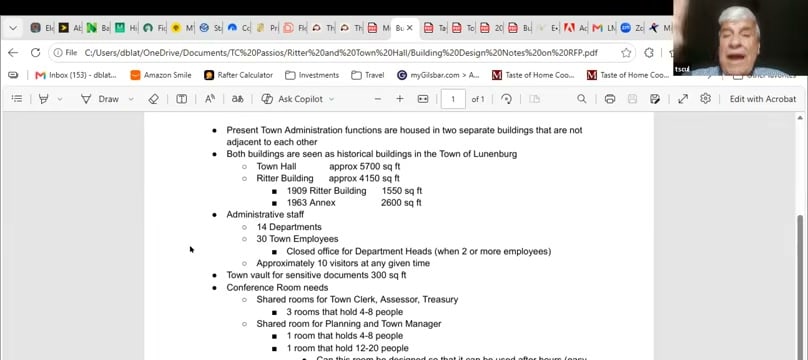
The committee confirmed its scope is limited to municipal functions tied to Town Hall and the Ritter building, aiming to consolidate town staff and narrow required square footage. The RFP is intended to produce a package that an architect can use to move into schematic design, including recommended square footage ranges and cost-per-square-foot guidance. The committee emphasized a desire to minimize cost and avoid "project creep," requesting firm estimates of hours and cost for the study phase rather than prescribing a fixed dollar limit that might exclude qualified firms.
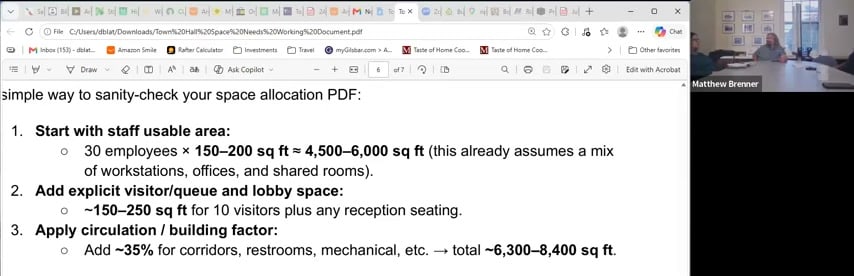
Planning assumptions include approximately 30 employees working in Town Hall and up to 10 visitors at a time, a figure one member thought might be high. The RFP will require several 4–6 person conference rooms and one 6–8 person room for staff, as well as one large conference room for 12–20 people for the Ritter group and larger meetings. The large room should preferably be located near an entrance to allow other town offices to be closed off while meetings run. The committee also agreed to highlight accessibility as a priority, emphasizing routes, entry, and restrooms beyond the baseline Americans with Disabilities Act requirements.
The committee discussed making the Town Hall basement usable for long-term storage, citing a prior estimate of approximately $100,000 from a Taylor & Burns study to replace the slab. Concerns were raised about archival storage below grade due to environmental, health, allergy, and moisture issues. The committee reached a consensus that a waterproofing solution is possible but requires engineering input, noting that any work should consider foundation breathability. The committee discussed the pros and cons of fieldstone foundation waterproofing; the architect or engineer will assess.
Regarding the existing one-story annex, Chris advised that demolition and rebuilding may be more cost-effective than re-leveling or digging down under the current structure due to plumbing and slab issues. The committee discussed potential futureproofing with unfinished upper floors but noted elevator and cost implications. The RFP should define parking needs based on employees on-shift plus expected visitors, without requiring detailed design in the initial scope. The committee also recommended the RFP include an option for flexible front or green-facing design if cost and feasibility allow, while noting that the TC Passios topic is to be handled separately.
The committee agreed to remove TC Passios and housing topics from its current agenda; the community center is also outside its charge, per Select Board direction. A School Committee representative requested that the TC Passios property remain available given an anticipated MSBA process submission in spring. The minutes note that TC Passios is subject to Architectural Preservation District Commission review, and any demolition must be vetted with the commission prior to Town Meeting action. Community guest Glenn Mcleod requested that the committee provide clear recommendations on consolidation viability as its work progresses.
- Approved the minutes of the September 21, 2026 meeting unanimously by roll call vote (motion by Matthew Brenner, seconded by Brian Lehtinen).
- The Chair will request the Town Clerk provide a calendar of monthly meetings to determine typical simultaneous meeting demand.
- Move out of "Also decided" and say the committee discussed opening restrooms to the public during after-hours events if cost-effective.
- The architect will identify baseline full-service upgrades for mechanical and utility systems, to be evaluated during a walkthrough.
- Adjourned the meeting, unanimously (motion by Laura Brzozoski, seconded by Anthony Sculimbrene).
- The next meeting is scheduled for October 26, 2026, at 5:30 PM.
A name wrong in this story? Tell us
A figure wrong in this story? Tell us
Know someone in the picture? Sign in to tell the editors — no password, a link by email.
Comments